
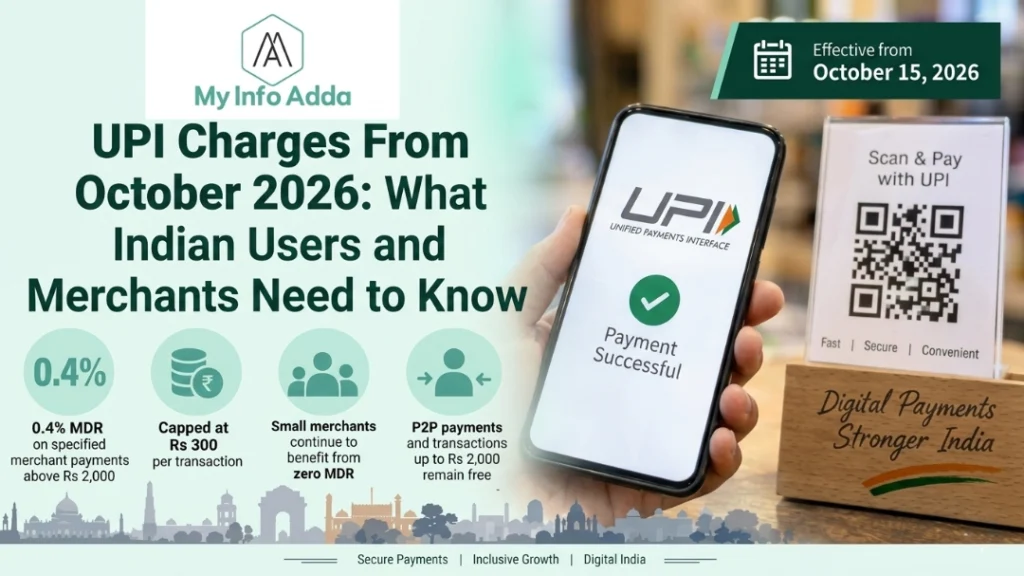

You’ve probably already seen headlines about UPI charges from October 2026 and wondered whether every payment will now cost extra. The important gap is that the new framework mainly changes the economics of selected merchant transactions, not ordinary person-to-person UPI payments; in this guide, we’ll explain exactly who pays, what changes from 15 October 2026, and which UPI limits still apply.
Key Takeaways
- UPI customers will not pay the new MDR directly, and person-to-person UPI transactions remain free.
- Eligible merchant transactions above ₹2,000 can attract MDR of up to 0.4% from 15 October 2026.
- UPI payments up to ₹2,000 remain free, including eligible merchant payments covered by the zero-MDR framework.
- Merchant Discount Rate (MDR) is different from a customer transaction fee because it is an ecosystem-level charge associated with eligible merchant payments.
- Approximately 96% of P2M UPI transactions remain unaffected, according to the Ministry of Finance.
- UPI transaction limits depend on the transaction category, while banks can set lower internal limits within applicable NPCI ceilings.
- RBI and NPCI announcements should be treated as the primary references when checking new UPI charges, limits, or payment rules.
What Are UPI Charges From October 2026?
UPI charges from October 2026 mainly refer to the Merchant Discount Rate (MDR) that will apply to certain UPI person-to-merchant transactions above ₹2,000 starting from 15 October 2026. This charge is typically paid by the merchant. Is not added directly to what the customer pays during a UPI transaction.
It’s important to understand that MDR is not the same as a customer transaction fee. The MDR is a cost within the payment ecosystem that covers the processing of merchant transactions. A customer transaction fee on the hand would mean an extra amount added to the user’s payment total.
For example if a customer pays ₹10,000 to a shop using a UPI transaction that qualifies under the rules they do not end up paying ₹10,040 just because of the MDR. The MDR is managed on the merchant side according to the rules and with taxes included in the process.
Also the October 2026 framework should not be mixed up with UPI setups involving PPI wallets, RuPay credit cards on UPI or other payment products. These earlier arrangements may have commercial terms or interchange fees, which are separate, from the new MDR framework.
Why Do UPI Charges and New Rules Matter?
UPI charges and new rules matter because they decide who pays for processing payments and whether a transaction stays free. Knowing the difference helps users avoid mixing up merchant-side MDR with an UPI fee.
For instance the Ministry of Finance said that 96% of P2M transactions will not be affected, while all P2P transactions still remain free.
Also UPI is a payment network. NPCI recorded 24,508.96 million UPI transactions ₹29,82,355.95 crore in August 2026. That shows why even small shifts in payment economics have impacts, on banks, merchants and payment apps
For businesses this change matters a lot because merchant payment costs can influence how settlements are calculated and how payment processing works. For background see
What Are the UPI Transaction Charges and New Rules for 2026?
The major change to UPI in 2026 is the introduction of MDR on P2M transactions that are above ₹2,000 starting from 15 October 2026. The National Payments Corporation of India or NPCI issued Circular OC-237/2026-27 on 15 September 2026 to set out this framework. The government has made it clear that customers should not be charged this MDR directly.
Will UPI users have to pay any charges from October 2026?
No UPI users will not have to pay the MDR directly. Person-to-person or P2P payments remain free no matter how much money is sent. Also payments to merchants that’re up to ₹2,000 stay free under the new rules.
For instance, transferring ₹5,000 directly to a friend is an example of a P2P transaction.
Continues to be free.. If you pay ₹5,000 to an eligible merchant that’s a P2M transaction and it could be subject to merchant-side MDR.
Google Pay for Business also states clearly that merchants cannot pass the MDR cost onto customers by adding a 0.4% fee when processing the UPI payment.
What is the difference between UPI P2P and P2M charges?
P2P stands for person-to-person payment. This means one individual sends money to another. P2M stands for person-to-merchant payment. This means someone pays a business or vendor through UPI.
The new MDR framework applies only to specified P2M transactions not to transfers between individuals.
So for instance ₹25,000 transferred from one person’s bank account to another person’s bank account is a P2P transaction. That remains free. But ₹25,000 paid to a retailer is a P2M transaction and if it exceeds ₹2,000 it may now fall under the MDR structure.
This distinction matters because P2P UPI payments stay free regardless of the amount. Eligible P2M payments, above ₹2,000 can be affected by the new MDR policy.
What Are the New UPI Transaction Rules in 2026?
The new UPI transaction rules in 2026 mix updated merchant pricing with the transaction‑category limits and payment‑system requirements. These guidelines do not impose one fixed transaction fee or limit that applies to all UPI payments.
How Does the RBI Regulate Charges on UPI Transactions?
To understand the applicable UPI charges, both RBI guidelines and NPCI regulations need to be considered, as NPCI manages the UPI network within the established regulatory framework.
The NPCI circular archive lists UPI circulars for FY 2026‑27 making it an important source for checking current operational changes.
Moreover the government stated in September 2026 that the new framework protects customers from UPI charges and keeps P2P transactions free.
For details use the internal resource when available.
Are UPI Bank Account Payments Free for Customers?
Under the October 2026 framework, customers are not charged for regular UPI payments made directly from their bank accounts.
The new MDR is not a customer‑facing surcharge on merchant payments.
For example if the displayed price of a purchase is ₹10,000 the customer should not be asked to add a separate 0.4% UPI fee.
That being said other payment products can have pricing arrangements so users should check the payment screen and bank/app information if a different charge appears.
How Much Can You Transfer Through UPI in a Single Day in 2026?
The UPI transaction limit per day in 2026 depends on the transaction type, participating bank and applicable NPCI rules than one single limit for every user. NPCI permits member banks to establish limits, within the prescribed ceilings.
What Is the Maximum UPI Transaction Limit Per Transaction?
The highest UPI transaction limit changes based on the type of payment. Some merchant categories that are verified can have limits. NPCIs rules have made it possible for some merchant categories to have increased limits for each transaction. However, P2P payment limits continue to follow the existing regulations.
NPCIs asked questions say that ₹1 lakh is the usual UPI transaction limit. Some categories like capital markets, collections, insurance, IPOs and Retail Direct Scheme transactions can have limits.
For example a transaction with a merchant that is allowed to have a higher limit might have a limit that’s more, than the usual ₹1 lakh. However the customers bank can still set a limit on their own.
What Are the UPI Charges for Merchants in 2026?
UPI charges for merchants in 2026 can include MDR on P2M transactions above ₹2,000 starting from 15 October 2026. The standard MDR rate is up to 0.4% with a charge of ₹300 for applicable transactions at or above the relevant cap.
For example a ₹10,000 eligible merchant payment at 0.4% produces ₹40 of MDR before any tax treatment.
Moreover payments up to ₹2,000 remain zero-MDR and specific categories can have concessional arrangements. Google Pay for Business identifies categories such as fuel, railways, insurance, telecom, utilities and other specified sectors under a ₹5 framework, for qualifying payments above ₹2,000.
What Is the Difference Between UPI Interchange Fees and Customer Charges?
A UPI interchange fee or MDR is an ecosystem-level payment cost and is different from a fee directly charged to a customer. The October 2026 framework specifically keeps the customer experience free at the point of payment while applying MDR to specified merchant transactions.
For example, if an eligible merchant receives ₹50,000, a 0.4% MDR would equal ₹200 before applicable taxes, while the customer still pays the billed ₹50,000.
This distinction is essential because the phrase “UPI charges” does not automatically mean “customer charges.”
What Is the UPI Charges Chart for 2026?
The UPI charges chart for 2026 shows that the applicable cost depends mainly on whether the transaction is P2P or P2M, its value, and the merchant category.
| Payment type | Customer charge | Merchant impact | Indicative limit/status |
| P2P UPI transfer | ₹0 | No new MDR | Free irrespective of amount |
| Merchant payment up to ₹2,000 | ₹0 | Zero MDR | Free under framework |
| Eligible P2M above ₹2,000 | ₹0 direct fee | Up to 0.4% MDR | Effective 15 Oct 2026 |
| Eligible P2M at ₹75,000+ | ₹0 direct fee | MDR capped at ₹300 | Subject to applicable category |
| Specified essential-sector P2M | ₹0 direct fee | Flat ₹5 for qualifying transactions above ₹2,000 | Category-specific |
| Higher-limit eligible merchant category | ₹0 direct fee | Depends on transaction category | NPCI ceiling + bank limit |
Source/status: NPCI framework, Ministry of Finance and current payment-provider guidance.
What Happens With a ₹500 UPI Shop Payment?
I find that a ₹500 eligible UPI merchant payment stays free under the October 2026 framework. Since the transaction is at or below ₹2,000 the new MDR does not apply.
I think a customer buying groceries worth ₹500 should pay ₹500 not an UPI processing fee.
What Happens With a ₹10,000 Online Purchase?
I see that a ₹10,000 eligible P2M UPI payment can attract 0.4% MDR on the merchant side from 15 October 2026.
I notice that at 0.4% the MDR calculation is ₹40, before taxes.
I notice that the customer pays the ₹10,000 billed amount while the merchant’s settlement economics account for the payment charge.
What Should UPI Users and Merchants Do Next?
UPI users and merchants need to make sure they know the charges and limits by checking with their bank the payment provider, RBI and NPCI. They should not trust messages that are forwarded or claims made on media. Rules for payments can be different depending on the type of transaction the kind of merchant and the institution involved.
First customers must look at the payment amount before they enter their UPI PIN. A real merchant should not add a charge of 0.4% for UPI just because the transaction is more than ₹2,000.
Second merchants need to look at the messages, from their acquiring bank their MCC classification and the settlement reports before they change their prices or payment methods. For help see.
Third businesses should. Check their transaction records on a regular basis. For users keeping records can offer protection.
What Are the Practical UPI Rules to Remember From October 2026?
The practical rule is simple: check the transaction type before assuming a UPI charge applies. A person-to-person transfer, a ₹500 shop payment and an eligible ₹10,000 merchant payment do not have the same payment economics.
For example, splitting a bill with a friend is P2P, while purchasing a product from a registered merchant is P2M.
Moreover, users should never share their UPI PIN to resolve a supposed fee issue. A payment request, refund request or support call should be verified through the official bank or payment application.
By following users can separate legitimate payment rules from fraudulent messages that claim a UPI charge must be paid through a separate transfer.
Conclusion: What the October 2026 UPI Changes Mean for Indians
The October 2026 UPI changes introduce merchant-side MDR for specified P2M transactions above ₹2,000 from 15 October, but they do not turn ordinary UPI payments into a universal customer-paid service. P2P transactions remain free, payments up to ₹2,000 remain free, and approximately 96% of P2M transactions are expected to remain unaffected.
Finally, the safest approach is to check the latest NPCI circulars, RBI guidance, bank notifications and payment-provider information before assuming a charge applies. For everyday users, the key message is straightforward: UPI is not becoming a paid service for every transaction; the October change mainly affects the merchant-side economics of selected higher-value payments.
Frequently Asked Questions About UPI Charges From October 2026
Will UPI become chargeable from October 2026?
No. UPI is not becoming a paid service for every transaction. Person-to-person UPI payments remain free, while specified merchant transactions above ₹2,000 may attract merchant-side MDR from 15 October 2026.
Will customers have to pay UPI charges from October 2026?
No. The new MDR is not a direct customer fee. Customers should not automatically be charged an additional 0.4% simply for making an eligible UPI payment.
What is the new UPI charge from October 2026?
The new framework introduces MDR of up to 0.4% for specified P2M UPI transactions above ₹2,000, subject to applicable category rules and the prescribed cap.
Are UPI payments below ₹2,000 free?
Yes. Eligible UPI merchant payments up to ₹2,000 remain zero-MDR, so customers are not expected to pay a separate UPI transaction fee for these payments.