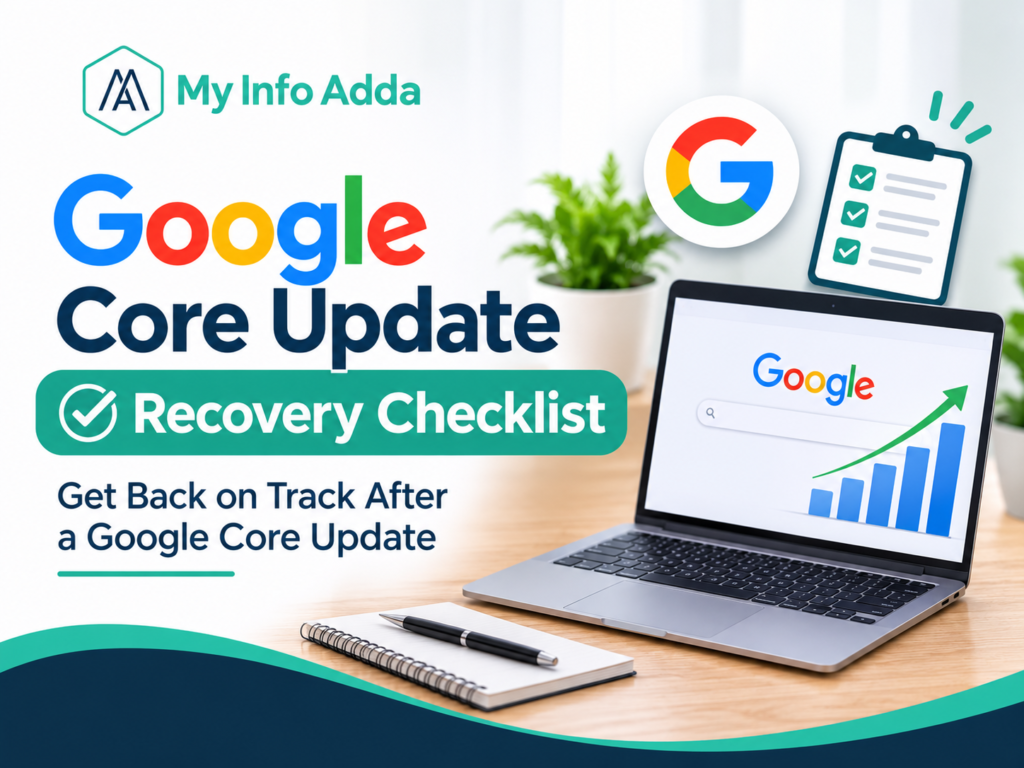

If your website had a drop in traffic from search engines or in the rankings of your keywords after Googles May 2026 core update you have probably already looked at Google Search Console.. Noticing a drop in traffic is only the first thing to do; figuring out which pages lost visibility and the reasons behind it needs more detailed work. In this guide we will explain how to look into changes, in rankings and follow a real-life checklist to deal with the Google core update.
Key Takeaways
- Google core update recovery involves identifying ranking changes and improving website quality, relevance and user experience.
- The May 2026 core update ran from May 21 to June 2, 2026, and its rollout is complete.
- Google Search Console helps identify affected pages, queries, impressions, clicks and average positions.
- Content quality and search intent should be reviewed before rewriting existing pages.
- Technical SEO issues, indexing problems and internal linking can also affect organic visibility.
- SEO recovery takes time, and improvements do not guarantee specific ranking positions.
What Is Google Core Update Recovery?
Google core update recovery is the process of analysing website ranking changes after a broad Google algorithm update and improving content quality, relevance and website experience to support long-term search visibility.
Moreover, a ranking decline does not automatically mean your website violated Google’s guidelines. Core updates reassess how Google’s systems identify relevant and helpful content.
May 2026 core update timeline:
| Event | Date |
| Update started | May 21, 2026 |
| Update completed | June 2, 2026 |
| Rollout duration | 11 days, 21 hours |
Importantly, a core update is different from a manual action, which involves a specific enforcement issue.
Why Does Google Core Update Recovery Matter?
Google core update recovery matters because declining search visibility can affect website traffic, enquiries and business revenue.
For example, a service page moving from position 3 to position 15 may receive fewer clicks and generate fewer enquiries.
However, not every traffic decline comes from an algorithm update. Reduced search demand, seasonal changes, CTR declines and technical problems can produce similar results.
How Can You Identify Pages Affected by the May 2026 Core Update?
Google Search Console helps website owners find pages and search terms that are having changes in clicks, impressions, CTR and average positions.
First wait at one full week after an update finishes before doing your main comparison. Google suggests this method in its core update documentation.
How to Check Google Core Update Impact in Search Console
Follow these steps:
- Open Google Search Console.
- Navigate to Performance → Search results.
- Select Web search.
- Open the date filter and choose Compare.
- Compare May 7–20 with June 10–23, 2026.
- Review clicks, impressions, average CTR and average position.
- Open Pages to identify declining URLs.
- Open Queries to identify affected keywords.
- Segment results by country and device.
- Compare branded and non-branded searches.
These dates are illustrative analysis windows, not dates officially prescribed by Google.
What Should You Include in a Google Core Update Recovery Checklist?
A Google core update recovery checklist covers ten essential SEO areas that help identify content, technical and visibility problems.
| SEO area | What to check |
| 1. Traffic analysis | Identify affected pages and queries. |
| 2. Content quality | Check usefulness, accuracy and completeness. |
| 3. Search intent | Compare content with current search results. |
| 4. Content freshness | Update outdated facts and examples. |
| 5. E-E-A-T | Review experience, expertise and trust signals. |
| 6. Technical SEO | Check indexing, canonicals and crawlability. |
| 7. Internal linking | Improve relevant links and navigation. |
| 8. Keyword cannibalization | Identify competing website URLs. |
| 9. Backlink profile | Investigate suspicious or unnatural patterns. |
| 10. User experience | Review readability, navigation and usability. |
Moreover, E-E-A-T is a useful content quality assessment framework, not a guaranteed ranking recovery factor.
For a deeper investigation, follow this complete SEO audit checklist for identifying website issues.
How Can You Improve Website Content After a Google Core Update?
Content improvement means making existing pages more useful, accurate and relevant instead of rewriting everything unnecessarily.
For example:
Before: “SEO is important for businesses because it improves website rankings and increases traffic.”
After: “SEO helps businesses attract relevant organic visitors by improving search visibility, matching content with user intent and resolving website issues. For example, a local service business can create dedicated service pages answering customer questions about pricing, location and available services.”
Additionally, prioritise these improvements:
- Answer important user questions directly.
- Remove repetitive and generic explanations.
- Add original examples and practical experience.
- Update outdated information and statistics.
- Improve headings and readability.
- Include relevant author information and credible references.
- Consolidate genuinely overlapping pages when appropriate.
Which SEO Tools Help Diagnose Google Algorithm Update Recovery?
SEO tools help identify traffic changes, keyword losses, technical problems and conversion declines.
| Tool | Primary purpose |
| Google Search Console | Clicks, impressions and rankings |
| Google Analytics 4 | Organic sessions and conversions |
| Semrush | Keyword and competitor tracking |
| Ahrefs | Backlink and competitor analysis |
| Screaming Frog | Technical SEO auditing |
| PageSpeed Insights | Performance and Core Web Vitals |
For example, if Search Console shows fewer clicks and GA4 also records fewer organic leads, the decline may be affecting business performance, not just keyword visibility.
How Long Does Google Core Update Recovery Take?
Google core update recovery does not have a fixed timeline because Google’s systems may take several months to recognise broader improvements in website quality.
Some changes can become visible within days, while broader improvements may take months. Google also confirms that websites do not necessarily need to wait for another announced core update to see improvements.
Importantly, Google has released subsequent spam updates after May 2026. Investigate their timelines separately rather than attributing every ranking change to the May core update.
What’s Next? Follow This 30-Day Google Core Update Recovery Plan
A 30-day recovery plan provides a structured schedule for implementing improvements and monitoring website performance.
| Timeline | Recommended action |
| Days 1–5 | Analyse Search Console and identify affected URLs. |
| Days 6–10 | Investigate content quality and search intent. |
| Days 11–15 | Review technical SEO and indexing. |
| Days 16–20 | Improve priority content and internal links. |
| Days 21–25 | Analyse competitors and missing information. |
| Days 26–30 | Monitor clicks, impressions and conversions. |
For businesses with multiple service pages, a well-planned SEO strategy for B2B businesses can help organise long-term content improvements.
This is an implementation schedule, not a promise of ranking recovery within 30 days.
Conclusion: Focus on Long-Term Google Core Update Recovery
Google core update recovery starts with figuring out why your website lost visibility not by making SEO changes. I have found that Google core update recovery is most effective when you analyze Search Console data, fix content that truly does not help solve problems and watch performance all the time.
If your website keeps falling in rankings Google core update recovery may need SEO services to improve organic visibility.
Need help finding your websites SEO problems?
I recommend requesting a website SEO consultation and discussing a recovery strategy.
Frequently Asked Questions About Google Core Update Recovery
1. How do I recover website rankings after a Google core update?
First, identify which pages and keywords lost visibility using Google Search Console. Then review content quality, search intent, technical SEO, internal linking and competitor pages. Improve affected pages based on actual user needs rather than making unnecessary website-wide changes.
2. What happened during Google’s May 2026 core update?
Google’s May 2026 core update started on May 21, 2026, and finished on June 2, 2026. The rollout is complete. Website owners should compare search performance before and after the update to identify significant ranking and traffic changes.
3. How do I check Google core update impact in Search Console?
Open Google Search Console and navigate to Performance → Search results. Compare pre-update and post-update date ranges, then examine clicks, impressions, average CTR and average position. Review the Pages and Queries reports to identify affected URLs and search terms.
4. Why did my website lose rankings after a Google core update?
Website rankings may decline because Google’s systems reassess content relevance, usefulness and overall search result quality. Competitor improvements, changing search intent, reduced search demand and technical SEO issues can also contribute to ranking losses.
5. Does a Google core update penalty mean my website violated Google’s guidelines?
No. A ranking decline after a Google core update does not automatically indicate a guideline violation. Core updates involve broad ranking reassessments, whereas manual actions are specific enforcement measures related to violations of Google’s spam policies.