

Introduction
In today’s modern digital world, websites and applications handle a massive amount of user traffic. If all incoming requests are sent to a single server, it can become overloaded, slow, or even crash. This is where Load Balancers play a critical role.
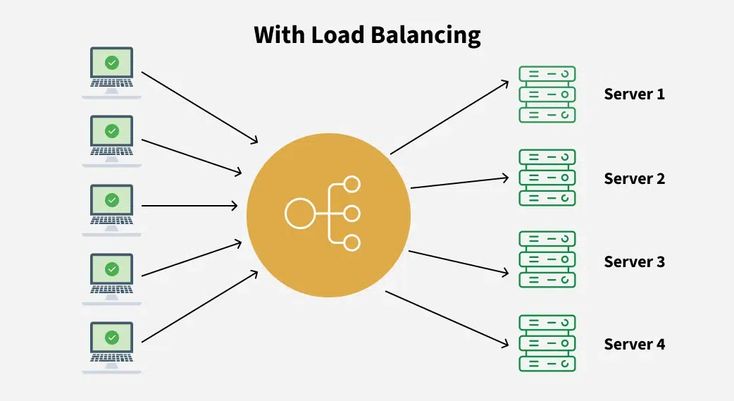
A load balancer intelligently distributes incoming traffic across multiple servers to ensure better performance, high availability, and reliability.
In this blog, we will cover:
- What a load balancer is
- Types of load balancers
- Common load balancing algorithms
- Real-world use cases
What is a Load Balancer?
A load balancer is a networking component that distributes incoming client requests across multiple backend servers (also called a server pool). Its main objectives are:
- Prevent server overload
- Ensure high availability
- Improve response time
For example, when you use platforms like Amazon, Netflix, or Google, a load balancer decides which server will handle your request.
Types of Load Balancers
1. Hardware Load Balancer
Hardware load balancers are physical devices installed in data centers.
Features:
- High performance
- Dedicated hardware
- Expensive compared to other options
Use Case: Large enterprises with very high traffic and sufficient budget.
2. Software Load Balancer
Software load balancers run on standard servers and are widely used today.
Popular Examples:
- NGINX
- HAProxy
- Apache
Features:
- Cost-effective
- Highly flexible
- Cloud-friendly
Use Case: Best suited for startups and mid-scale applications.
3. Cloud Load Balancer
Cloud providers offer managed load balancing services as part of their platforms.
Examples:
- AWS Elastic Load Balancer (ELB)
- Google Cloud Load Balancing
- Microsoft Azure Load Balancer
Features:
- Automatic scaling
- High availability
- Minimal maintenance
Use Case: Cloud-native applications where scalability and reliability are essential.
Load Balancing Algorithms
1. Round Robin
Requests are distributed to servers sequentially, one after another.
Pros:
- Simple and easy to implement
Cons:
- Does not consider the current load on servers
2. Least Connections
The next request is sent to the server with the fewest active connections.
Pros:
- Better load distribution in dynamic environments
Best For: Applications where request processing time varies.
3. IP Hash
The client’s IP address is used to determine which server will handle the request.
Pros:
- Maintains session persistence
Use Case: Login-based or session-dependent applications.
4. Weighted Round Robin
Each server is assigned a weight based on its capacity. Servers with higher capacity receive more traffic.
Pros:
- Efficient utilization of powerful servers
Use Cases of Load Balancers
1. High-Traffic Websites
E-commerce platforms like Amazon or Flipkart use load balancers to handle traffic spikes during sales.
2. Microservices Architecture
Load balancers distribute traffic among multiple microservices to ensure smooth communication.
3. High Availability Systems
If one server fails, the load balancer automatically redirects traffic to healthy servers.
4. Cloud and DevOps Environments
Load balancers are widely used in CI/CD pipelines, containerized applications (Docker, Kubernetes), and cloud deployments.
Benefits of Using Load Balancers
- Improved application performance
- Fault tolerance
- Scalability
- Better user experience
Conclusion
Load balancers have become the backbone of modern applications. Whether you are building a small startup application or a large enterprise system, load balancers help make your infrastructure scalable, reliable, and efficient.
Understanding load balancers is an essential skill for anyone learning system design, cloud computing, or DevOps.